How much does a dental crown cost in Lima and Peru? 2026 prices
Dental crown in Lima: price from S/ 850
Learn the price per crown by material, the differences between zirconia, lithium disilicate and porcelain-fused-to-metal, and how the most suitable treatment is chosen for each patient.
From S/ 850 depending on the material
Compare porcelain-fused-to-metal, lithium disilicate and zirconia. The recommendation is made after evaluating the tooth, the bite and your aesthetic needs.
The cost of a dental crown depends on each tooth’s needs
There is no single price for all dental crowns
The estimate may vary depending on the material chosen, the condition of the tooth, the need for root canal treatment or a fiber post, and whether the crown will be placed on a natural tooth or on an implant.
For this reason, before giving a final price, a clinical evaluation is necessary to determine which type of rehabilitation will provide better strength, function, and aesthetics.
At V&C Odontólogos, we evaluate the tooth and plan the treatment in a personalized way at our San Borja and Barranco clinics.
How much does a dental crown cost in Lima?
Learn the price per crown by material. During the evaluation we determine which one offers the best balance of strength, aesthetics and function for your case.
Prices include making and placing the crown. If the tooth needs a root canal, a build-up, a fiber post or gum treatment, these procedures are evaluated and quoted separately.
Porcelain-fused-to-metal crown
It combines an internal metal structure with a porcelain covering. It can be used in certain restorations when strength and function are the priority.
- ✓ Good mechanical strength
- ✓ Alternative for different areas of the mouth
- ✓ Recommended according to bite and available space
Zirconia
A high-strength ceramic material that allows metal-free restorations with an appearance that blends with natural teeth.
- ✓ High strength and stability
- ✓ No visible metal structure
- ✓ May be used on posterior or anterior teeth
Lithium disilicate
An aesthetic ceramic that reproduces color, shine and translucency. Its use depends on the position of the tooth, the bite and how much tooth structure remains.
- ✓ Aesthetic and natural finish
- ✓ Good integration with the smile color
- ✓ Personalized indication according to each case
What does the dental crown include?
- Evaluation of the tooth that will be restored.
- Material selection according to function and aesthetics.
- Clinical preparation and digital impression taking.
- Design, fabrication, try-in, and placement of the crown.
- Review of fit, contacts, and bite.
What could be estimated separately?
- Endodontic treatment when the tooth nerve is affected.
- Fiber post or reconstruction of the tooth core.
- Treatment of cavities, gums, or active structures.
- Extraction and implant placement when the tooth cannot be preserved.
- Additional procedures identified during the diagnosis.
The best crown is the one that suits the tooth, the bite, the aesthetic requirements and the clinical prognosis of the patient. The choice should be made after a professional evaluation.
When is a dental crown needed?
A crown is used to cover and protect a tooth that has lost strength, structure, or shape. However, not all damaged teeth necessarily need a crown.
Restore function without removing more tooth structure than necessary
The crown covers the visible part of the tooth and helps restore strength, stability, shape, and appearance. Its indication should be based on the diagnosis, the amount of remaining tissue, and the way the patient bites.
Extensive decay
When decay has destroyed a large part of the tooth and a conventional restoration no longer provides enough strength or stability.
Fractured tooth
It may be indicated when there is an important fracture, a weakened cusp, or a risk that the tooth may continue breaking.
After endodontic treatment
Some endodontically treated teeth, especially posterior teeth with little remaining structure, need protection to reduce the risk of fracture.
Severe dental wear
In patients with bruxism, erosion, or significant loss of tooth height, a crown may be part of a broader rehabilitation.
Deteriorated old crown
Replacement may be needed when there are leaks, cavities, fractures, bite changes, or adaptation problems.
Implant-supported rehabilitation
A crown can also be placed on a dental implant to replace the visible part of a missing tooth.
Endodontic treatment does not automatically mean you will always need a crown
The decision depends on the type of tooth, the amount of remaining structure, the size of the restoration, and bite forces. Weakened molars and premolars usually require greater protection,while some anterior teeth may be restored in another way.
Weakened tooth or extensive structure loss
The crown helps distribute forces and protect the remaining dental tissue when a smaller restoration would not be enough.
Tooth with enough healthy structure and localized damage
Depending on the case, a filling, inlay, veneer, or adhesive restoration may be evaluated to preserve more tooth structure.
We can evaluate how much dental tissue remains and explain whether you need a crown or if there is a more conservative alternative.
Do you always need a crown after endodontic treatment?
Not necessarily. The decision depends on the type of tooth, the amount of healthy structure remaining, the size of the restoration, and the forces the tooth receives during the bite.
Endodontic treatment treats the inside of the tooth, but the final restoration must restore strength
After eliminating internal infection or inflammation, the tooth needs a restoration that seals the access and helps recover its function. When there is extensive structure loss, a crown or full-coverage restoration may help reduce the risk of fracture.
Posterior teeth
Molars and premolars receive significant forces during chewing. If they have lost a considerable amount of structure, they often need a restoration that protects their cusps.
Anterior teeth
In some incisors or canines, an adhesive reconstruction may be possible, depending on the damage, color, bite, and amount of preserved dental tissue.
How is the final restoration decided?
The indication is made after reviewing the tooth clinically and radiographically, not only because it has received endodontic treatment.
Review the remaining structure
The amount of healthy dentin and enamel remaining after removing decay, old restorations, and weakened tissue is evaluated.
Evaluate the bite
The position of the tooth, the forces it receives, and the possible presence of clenching or bruxism are analyzed.
Choose the reconstruction
Depending on the case, a filling, inlay, endocrown, fiber post, or conventional crown may be indicated.
Seal and monitor
The restoration is fitted, the bite is checked, and follow-up visits are indicated to monitor the tooth and surrounding tissues.
Composite resin reconstruction
May be considered when enough structure remains and the tooth does not need full coverage to withstand forces.
Inlay or endocrown
In certain cases, it allows weakened areas to be covered while preserving more tooth structure than a conventional full-coverage preparation.
Dental crown
Indicated when the tooth needs broader protection to restore shape, strength, stability, and chewing function.
A fiber post does not automatically strengthen every tooth
Its main function is to help retain the reconstruction when there is not enough coronal structure. It should only be placed when indicated. You can learn more about this treatment on our endodontics in Lima page. .
It is important to evaluate the tooth to determine what type of reconstruction it needs and prevent it from remaining unprotected.
How is a dental crown made with digital technology?
The digital workflow allows us to record the mouth, design the restoration, and check its fit using tools that support more precise planning and a more comfortable experience for the patient.
From intraoral scanning to crown design and fabrication
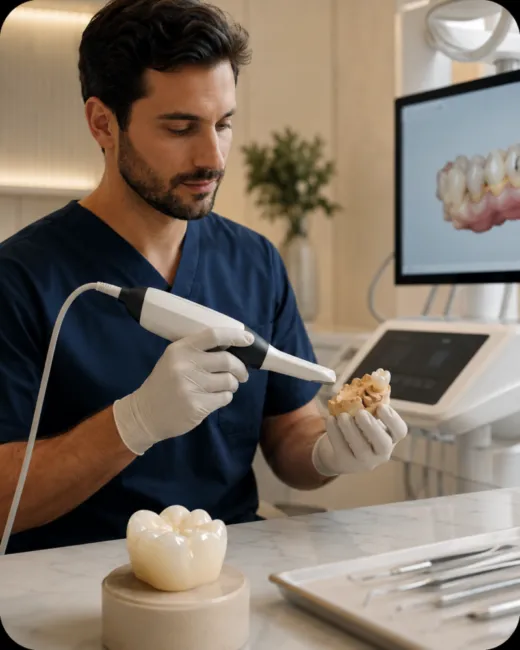
At V&C Odontólogos, we use digital dentistry tools to record the dental preparation and plan the restoration. Depending on the case, the crown can be designed with specialized software and fabricated using CAD/CAM technology.
Record without traditional impressions
In many cases, the intraoral scanner allows us to obtain a digital model without using trays with impression materials.
Restoration visualization
The design can be reviewed digitally before fabrication, considering the anatomy and neighboring teeth.
Fit and bite control
Technology supports the planning of contacts, dimensions, and the relationship of the crown with the patient’s bite.
Treatment stages
The number of appointments and timelines may vary depending on the condition of the tooth, the material chosen, and the need for previous treatments.
Evaluation and diagnosis
The tooth, tissues, bite, and necessary radiographic studies are reviewed.
Tooth preparation
Deteriorated tissue is removed and the tooth is conditioned to receive the indicated restoration.
Intraoral scanning
The prepared tooth, neighboring teeth, and relationship between both arches are digitally recorded.
Design and fabrication
The anatomy is planned and the crown is fabricated using the material selected for the case.
Try-in and placement
Fit, color, contacts, and bite are checked before final cementation.
It is not enough for the restoration to look good
A crown must also fit correctly, allow a stable bite, maintain proper contacts, and support good hygiene.
The adaptation at the junction between the tooth and the crown is reviewed.
The relationship with the teeth located on each side is checked.
Contact points are adjusted when closing and chewing.
Anatomy, proportion, color, and harmony with the smile are evaluated.
Digital technology does not replace clinical diagnosis
The equipment helps record, design, and fabricate the restoration, but the indication of the material, tooth preparation, and final placement depend on the professional evaluation.
We can review the condition of your tooth, show you the digital record, and explain which material and type of restoration may best suit your case.
How long does a dental crown last and how should you care for it?
A crown does not have an exact duration for every patient. Its longevity depends on the condition of the tooth, the material, the bite, hygiene, habits, and dental check-ups.
A well-indicated and properly cared-for crown can function for many years
In general terms, a dental crown can last approximately between 10 and 15 years, although some restorations may last longer and others may need replacement earlier. This is not a guarantee, since each mouth has different clinical conditions and habits.
The crown does not protect against new cavities
The tooth underneath can still develop decay, especially near the edge of the restoration if plaque accumulates.
The gum also influences the result
Inflammation, bleeding, or gum recession can affect the appearance, access for hygiene, and prognosis of the crown.
Factors that influence its lifespan
The quality of the material is important, but it is not the only element that determines how long a restoration will function.
Condition of the tooth
The amount of healthy structure, root support, and tissue health influence the prognosis.
Crown fit
Proper fit helps maintain the seal, contacts, and correct hygiene around the restoration.
Bite forces
Bruxism, clenching, or excessive contacts can increase wear, loosening, or fracture risk.
Hygiene and check-ups
Daily cleaning and check-ups help detect cavities, inflammation, wear, or changes before they progress.
Recommended care
A crown is cleaned in a similar way to a natural tooth, paying special attention to the junction between the restoration and the gum.
Signs that a crown needs to be checked
These symptoms do not always mean that the crown needs to be replaced, but they do justify an evaluation to identify the cause.
An old crown should not be replaced only because of time
If it maintains good fit, function, aesthetics, and tissue health, it may continue to be used. The decision to replace it should be based on clinical and radiographic findings.
We can check its fit, the condition of the tooth, gum health, and bite to determine whether it needs maintenance, recementation, or replacement.
Common questions about dental crowns
These answers provide general information. The indication, material, and final price depend on each patient’s clinical evaluation.
01 How much does a dental crown cost in Peru?
At V&C Odontólogos, the price of a dental crown is fixed by material: S/ 850 for porcelain-fused-to-metal, S/ 1,200 for lithium disilicate and S/ 1,350 for zirconia, including fabrication and placement. Before giving a final quote, we check whether the tooth needs a root canal, a buildup, a fiber post or another complementary procedure.
02 Which crown is better: zirconia or lithium disilicate?
There is no single material that is best for every patient. Zirconia stands out for its strength, while lithium disilicate offers good aesthetic properties. The choice depends on the location of the tooth, the bite, the available space, and the amount of tooth structure.
03 Does getting a dental crown hurt?
Tooth preparation is usually performed under local anesthesia, so the patient should not feel pain during the procedure. Temporary sensitivity may occur after the appointment, especially if the tooth is still vital.
04 How long does the treatment take?
The time depends on the diagnosis, the material, and the fabrication workflow. Some cases can be completed in a few appointments, while others require endodontic treatment, gum treatment, or reconstruction before fabricating the final crown.
05 Is a fiber post needed before placing a crown?
Not all teeth need a post. It is mainly used when there is little coronal structure to retain the reconstruction. The indication depends on the amount of remaining tissue, the root, and the type of restoration planned.
06 Can a dental crown get cavities?
The crown material itself does not develop cavities, but the tooth underneath can be affected, especially at the junction between the restoration and the tooth structure. That is why hygiene, flossing, and regular check-ups are important.
07 What happens if a dental crown comes off?
The crown should be kept and you should attend an evaluation. It is not recommended to glue it at home. The dentist must check the tooth, the fit, the cement, and the possible presence of decay or fractures before deciding whether it can be recemented.
08 What is the difference between a crown on a tooth and a crown on an implant?
A crown on a tooth is placed over a prepared natural tooth. An implant-supported crown replaces the visible part of a missing tooth and is connected to an implant through a prosthetic component. You can learn more on our dental implant treatment in Lima .
09 Can an old dental crown be replaced?
Yes, but there must be an indication. A crown may be replaced due to decay, leakage, fracture, poor fit, aesthetic issues, or bite changes. If it works properly, it does not necessarily need to be changed only because it has been in place for several years.
10 How do I know if I need a crown, an inlay, or a filling?
The decision depends on how much healthy structure the tooth still has, the location of the damage, and the bite forces. Whenever possible, the goal is to protect the tooth while preserving as much dental tissue as possible.
The information in this guide does not replace a dental evaluation
Diagnosis requires reviewing the tooth, gums, bite, and any necessary radiographic studies. The estimate is determined after identifying the real needs of the case.
The cost of a dental crown should be evaluated together with the condition of the tooth
Comparing only the price can lead to choosing an alternative that is not appropriate for function, bite, or the amount of preserved dental tissue. Diagnosis helps define which treatment, material, and procedure each patient really needs.
The best crown is not necessarily the most expensive one, but the one best indicated for your case
Before placing a crown, the tooth structure, bite, gums, and need for complementary treatments should be reviewed. With this information, a restoration can be chosen that aims to restore function, strength, and aesthetics..
Related treatments
Learn about other areas that may be part of the diagnosis, reconstruction, or rehabilitation of a damaged or missing tooth.
Dental crowns
Learn about the types of crowns and how this treatment is planned at V&C Odontólogos.
View treatment → 02Oral rehabilitation
Comprehensive treatments to restore function, stability, support, and dental aesthetics.
Learn more → 03Endodontics
Treatment focused on preserving teeth affected by inflammation, infection, or damage to the dental pulp.
View endodontics → 04Dental Implants in Peru
A rehabilitation alternative when a tooth cannot be preserved or has already been lost.
View implants →Choose the most convenient clinic to evaluate your dental crown
Message us on WhatsApp to check availability and coordinate an evaluation at V&C Odontólogos. The estimate is provided after reviewing the clinical needs of your case.
San Borja
Av. de las Artes Norte 364, San Borja, Lima.
Barranco
Av. San Martín 459, Barranco, Lima.
You can also write to us at citas@vycodontologos.com to request information about your evaluation.
View contact informationThe information in this article is educational and does not replace a dental evaluation. The diagnosis, material, treatment time, and final estimate depend on the clinical conditions and specific needs of each patient.