How long does a dental implant last?
How long does a dental implant last?
A dental implant can last many years, but how long it lasts depends on several factors: the patient’s oral health, bone quality, treatment planning, the final restoration and aftercare.
In this article we explain what affects the lifespan of an implant, how to care for it properly and why a personalized evaluation is key before starting treatment.
In short
- A dental implant can last many years with good care.
- Oral hygiene and regular check-ups are essential.
- The crown on the implant may need maintenance or replacement over time.
- Digital planning helps evaluate each case better.
- How long it lasts depends on the patient’s oral health and habits.
How long can a dental implant last?
A dental implant can stay in good condition for many years when the treatment is well planned and the patient maintains good oral hygiene, regular check-ups and healthy habits.
However, it is not correct to say that all implants last the same. How long they last depends on factors such as bone quality, gum health, the technique used, the final restoration and the patient’s daily care.
In short: a dental implant can last a long time, but its lifespan does not depend only on the implant. Planning, the crown, hygiene, check-ups and the patient’s health also play a role.
En V&C Odontólogos, each case is evaluated individually before recommending implant treatment. This allows the condition of the bone, the gums and the restorative needs to be reviewed before starting the procedure.
Learn more about our dental implants in LimaThe implant, the abutment and the dental crown are not the same
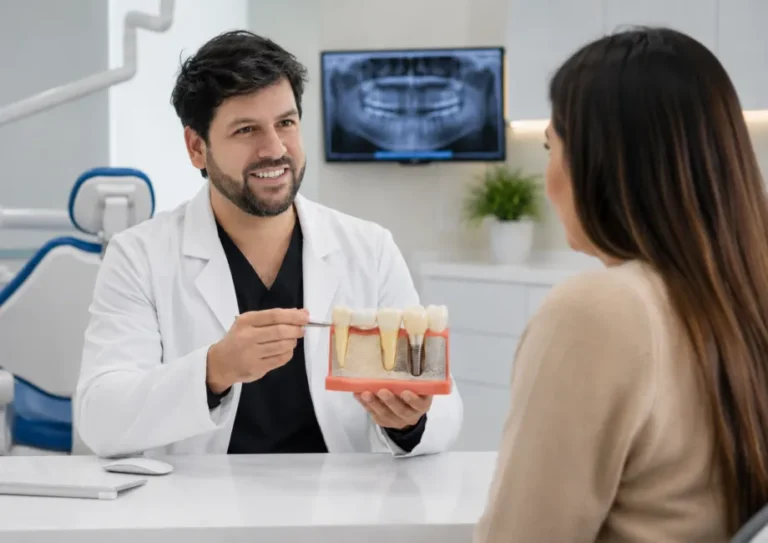
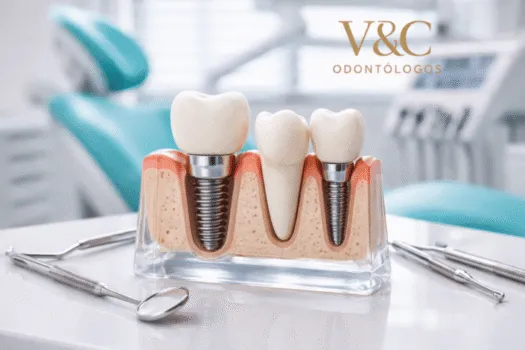
When talking about how long a dental implant lasts, it is important to distinguish the parts of the treatment. Patients often call the whole replaced tooth an “implant”, but several components are actually involved.
Dental implant
It is the biocompatible screw placed in the bone to act as an artificial root. Its stability depends on its integration with the bone and long-term maintenance.
It is the artificial root that is placed in the bone and serves as the base of the treatment.
It is the piece that connects the implant to the crown. Its role is to allow a proper fit between the artificial root and the visible restoration.
Dental crown
It is the visible part that replaces the tooth. Over time it may need maintenance, adjustment or replacement, especially if there is wear, a fracture or changes in the bite.
That is why, when a patient asks how long a dental implant lasts, the lifespan of the final restoration must also be considered. In some cases the implant can remain stable while the crown needs maintenance or replacement over time.
What does the lifespan of a dental implant depend on?
How long a dental implant lasts depends on a combination of clinical factors and patient habits. That is why a personalized evaluation is important before starting treatment, to know the condition of the bone, gums, bite and general health.
Gum health
Healthy gums help maintain a suitable environment around the implant. Inflammation or periodontal disease can affect the stability of the treatment if it is not controlled in time.
Bone quality and quantity
The implant needs to integrate with the bone. If there is bone loss, additional procedures or more detailed planning may need to be evaluated before placing it.
Daily oral hygiene
Good hygiene helps reduce plaque build-up around the implant, the crown and the gums. Home care is key to maintaining the treatment.
Regular check-ups
Check-ups make it possible to evaluate implant stability, tissue health, the bite and the condition of the crown. They also help detect problems early.
Patient habits
Smoking, bruxism, an unbalanced bite or chewing hard objects can affect the lifespan of the implant or the crown on it.
Quality of the restoration
The crown or prosthesis on the implant must fit correctly. A well-designed restoration helps distribute biting forces better and makes cleaning easier.
En V&C Odontólogos, treatment planning is not limited to placing the implant. The final restoration, bite, aesthetics and long-term maintenance are also evaluated.
What can shorten the lifespan of a dental implant?
Although dental implants are designed to be a stable and long-lasting solution, some factors can affect how they evolve over time. Some depend on the patient’s clinical condition and others on their daily habits.
Identifying these factors from the initial evaluation allows better treatment planning and helps explain to the patient what care they will need to keep their implant in good condition.
Common risk factors
- Poor oral hygiene.
- Plaque or tartar build-up around the implant.
- Uncontrolled periodontal disease.
- Smoking.
- Bruxism or teeth clenching.
- Irregular dental check-ups.
- Uncorrected bite problems.
- Chewing very hard foods or objects.
Having one or more risk factors does not necessarily mean the implant cannot be placed. It means the case must be evaluated in more detail to define the best treatment, check-up and maintenance plan.
How should you care for a dental implant so it lasts longer?
Caring for a dental implant does not end when the procedure is over. To keep it in good condition, it is important to follow a proper hygiene routine, attend check-ups and watch habits that can affect the health of the gums or the crown.
Daily brushing
Brushing properly helps control plaque around the crown, gum and implant. The technique should be adapted to each patient and type of restoration.
Use of floss or interdental brushes
Cleaning between teeth or around implant-supported prostheses is key. In some cases special floss, a water flosser or interproximal brushes may be recommended.
Regular check-ups
Check-ups make it possible to evaluate gum health, implant stability, crown fit and the bite. How often depends on each case.
Avoid harmful habits
Biting hard objects, smoking or leaving bruxism untreated can affect the lifespan of the implant or the crown. These habits should be discussed during check-ups.
A dental implant needs maintenance, just like natural teeth. The difference is that professional follow-up helps detect small changes before they become bigger problems.
Why does planning affect how long an implant lasts?
The lifespan of a dental implant does not depend only on the implant material. It also depends on a proper evaluation before treatment, good implant positioning, a suitable restoration and regular maintenance.
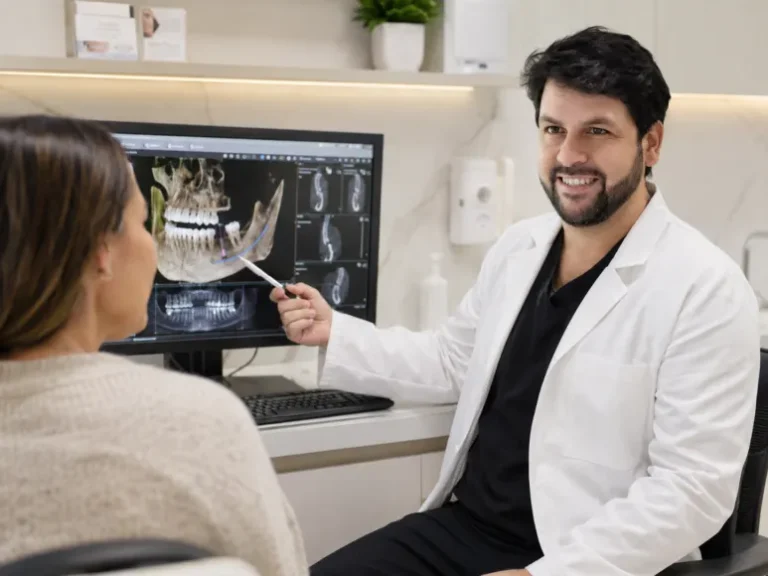
At V&C Odontólogos, planning can include a 3D CT scan to analyze the bone, an intraoral scanner for digital impressions and CAD/CAM technology to design restorations more precisely.
This planning helps define the case better before starting treatment and makes it possible to combine function, aesthetics and long-term maintenance.
Technology applied to treatment
- 3D CT scan to evaluate the bone.
- Intraoral scanner for digital impressions.
- Digital case planning.
- Design of the final restoration.
- CAD/CAM technology.
- In-house digital laboratory.
- Sirona PrimeMill milling unit.
- Sirona SpeedFire furnace.
Why are check-ups important after a dental implant?
Dental check-ups are essential to review how the implant is doing, gum health, the condition of the crown and the way the patient is biting. Even if the implant feels comfortable, it is important to have it evaluated regularly.
During these check-ups, the dentist can detect plaque build-up, gum inflammation, crown wear, changes in the bite or early signs that could affect the lifespan of the treatment if not addressed in time.
A check-up can review:
- Condition of the gum around the implant.
- Hygiene and plaque or tartar build-up.
- Stability of the implant and the restoration.
- Fit of the crown or prosthesis.
- Bite and distribution of forces.
- Need for professional maintenance.
En V&C Odontólogos, maintenance is part of the comprehensive treatment approach. The goal is not only to place the implant, but to help the restoration work properly in the long term.
You may also be interested in
If you are considering a dental implant, it is also important to learn about other treatments and resources that may be part of the diagnosis, planning or final restoration.
Dental implants in Lima
Find out how we plan dental implant treatments at V&C Odontólogos.
Does getting a dental implant hurt?
Answers one of the most common questions before starting implant treatment.
Oral rehabilitation in Lima
Oral rehabilitation restores function, aesthetics and stability in more complex cases.
Dental crowns in Lima
Crowns can be part of the final restoration on implants or natural teeth.
Common questions about how long dental implants last
Does a dental implant last a lifetime?
A dental implant can last many years, but it should not be promised that it will last a lifetime in every case. How long it lasts depends on hygiene, check-ups, gum health, bone quality, the patient’s habits and treatment planning.
Does the crown on the implant last as long as the implant?
Not necessarily. The implant is the artificial root placed in the bone, while the crown is the visible part that replaces the tooth. The crown may need maintenance, adjustment or replacement over time.
What happens if I do not go to check-ups after getting an implant?
Without check-ups, problems such as gum inflammation, plaque build-up, crown wear or changes in the bite can go unnoticed. Detecting these changes in time helps take better care of the treatment.
Can bruxism affect a dental implant?
Yes. Bruxism or teeth clenching can put excessive force on the crown, the prosthesis or the implant. In these cases, the dentist may consider night guards, bite adjustments or more frequent check-ups.
Does smoking shorten the lifespan of a dental implant?
Smoking can affect gum health, healing and the maintenance of the tissues around the implant. That is why it should be considered in the evaluation and the maintenance plan.
How do I know if my implant is in good condition?
The best way to know is through dental check-ups. The specialist can check the gum, the stability of the restoration, the bite and hygiene and, if necessary, request additional studies.
Have your case evaluated before getting a dental implant
If you are thinking about replacing a missing tooth with a dental implant, book an evaluation at V&C Odontólogos. We will review your case, the condition of your bone and gums, and the most suitable restorative options for you.
Care in Lima, Peru. Treatment recommendations depend on a personalized clinical and radiographic evaluation.